

NB Hip Line Design · Women
A hip line is not about adding volume but about designing the curve that flows from waist to thigh
NB Hip Line Design assesses pelvic width, waist space, side hip hollowing, upper hip volume, hip dip, subgluteal fold and the thigh connection together, and proposes a design direction suited to your individual body structure.
Your Hip-Line Story
Have you had moments like these?
Hip line concerns may not simply come from a lack of fat. The pelvic shape, muscle coverage, fat layer, skin elasticity and the position of the subgluteal line all need to be considered together.

- 01The side hip looks flat and clothes don't sit well
- 02The upper hip looks sunken, leaving the back view flat
- 03A prominent hip dip breaks up the line
- 04The buttocks look square or elongated
- 05The subgluteal line sags and the dimple stands out
- 06The transition between waist and hip is not smooth
- 07The connection between hip and thigh looks bulky
Connected Line Insight
Why we read the waist-pelvis-side hip-upper hip-subgluteal-thigh connection together
Even when a hip dip or a sunken side hip looks the same, the cause can differ. The design direction needed can vary depending on pelvic width, iliac height, waist space, the fat layer, skin elasticity and the way the hip connects to the thigh.
Waist
The starting point created by the waist space and pelvic width
Pelvis
Pelvic width and iliac height determine the vertical length of the hip
Side hip
The depth and position of the lateral curve
Upper hip
The position of the upper volume and any sagging
Subgluteal fold
The position of the subgluteal fold and the dimple line
Thigh
The flow that continues from the hip into the thigh


* This is not a surgery that changes the pelvic bone itself, but a procedure that assesses the design direction possible within your individual structure. The possible range and method can vary depending on pelvic structure, the fat layer, skin elasticity and any previous surgery.
Hip-Line Procedures
NB Hip Line Design 7 precise design elements
From upper hip volume, lateral hip hollowing, sagging and cellulite to the subgluteal dimple and the Venus dimple — see how each procedure connects within one continuous line.


01
Hip Line Design
Hip Line Design
We redesign the entire waist-to-hip line in balance.
When the buttocks look square or elongated

02
Elasticum Hip Lift
Elasticum Hip Lift
A non-surgical approach that lifts sagging hips for a firmer look.
When the hips sag downward and make the legs look shorter

03
Hip Dip & Lateral Pelvic Hollow Correction
Hip Dip Correction
We fill the hollowed lateral pelvis into a natural curve.
When a prominent hip dip breaks up the line

04
Apple Hip Shaping
Apple Hip Shaping
We design a rounded, firm-looking upper hip volume.
When the upper hip looks sunken and the back view is flat
05
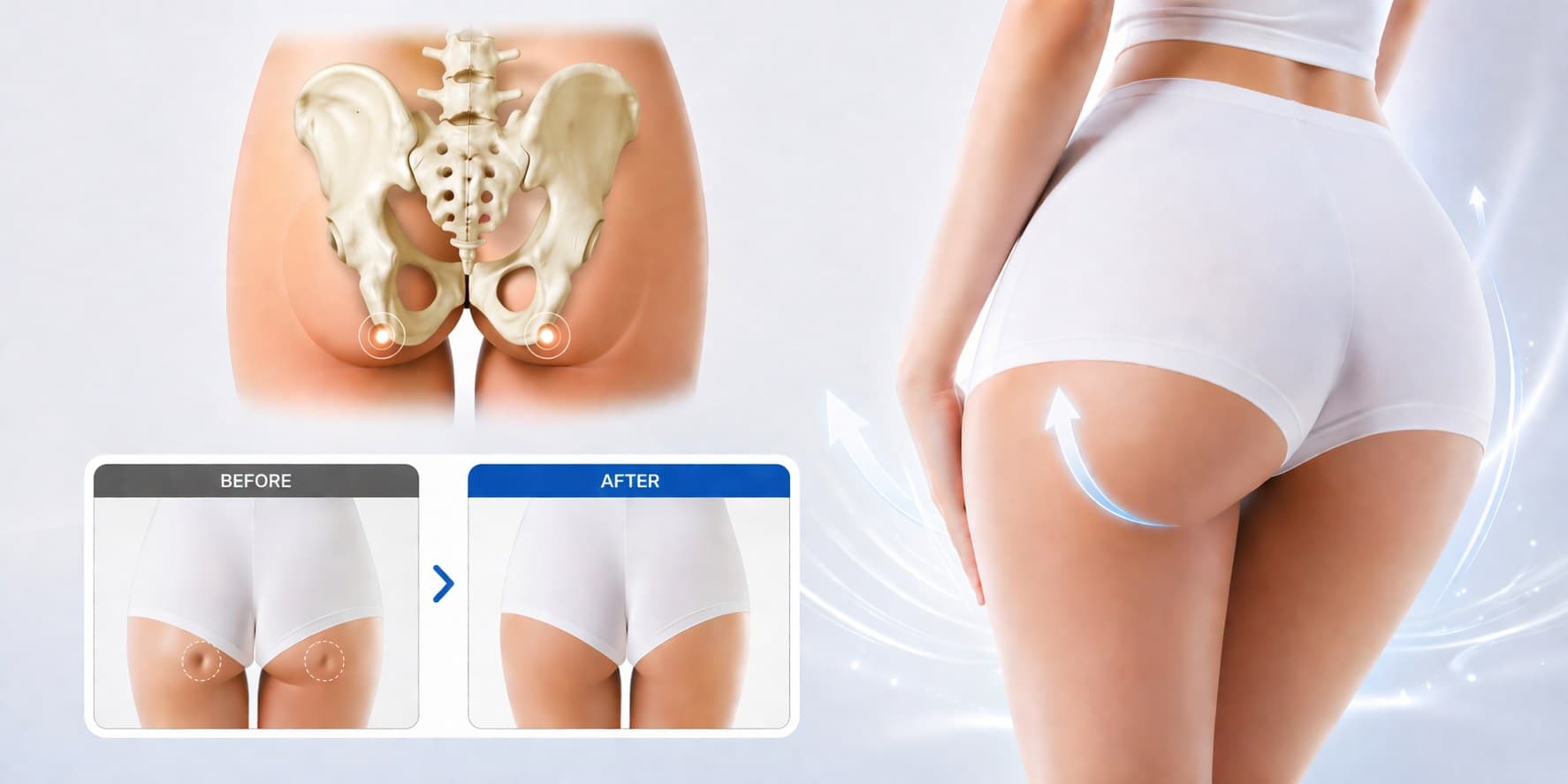
Subgluteal Dimple Hollow Correction
Subgluteal Dimple
We release the adhesion bands at the ischial tuberosity and address the hollow and pigmentation together.
When the subgluteal line sags and the dimple stands out

06
Cellulite & Dimple Correction
Cellulite Correction
We gradually smooth an uneven skin surface.
When the texture of the skin surface bothers you

07
Venus Dimple Contouring
Venus Dimple
We create a natural Venus dimple line at the waist-to-hip junction.
When the transition between waist and hip is not smooth

Self Check
Which type is your hip line?
Choose the card among the six types below that most closely matches your own shape. Each type links to a suitable procedure direction. Actual suitability, however, is decided during the consultation after reviewing your individual structure.
Flat upper hip type
Lack of upper hip volume
When the upper hip looks sunken and the back view is flat
Apple Hip Shaping + Hip Line Design
Sagging hip type
Hip sagging
When the hips sag downward and make the leg proportions look shorter
Elasticum Hip Lift
Hip dip type
Lateral pelvic hollow
When the lateral pelvis is hollowed and the line is broken
Hip Dip & Lateral Pelvic Hollow Correction
Square hip type
Long, square impression
When the buttocks look long and square
Integrated Hip Line Design
Sagging subgluteal type
Subgluteal line sagging
When the subgluteal line sags and the dimple stands out
Subgluteal Dimple Hollow Correction
Cellulite type
Uneven skin surface
When the skin surface is uneven
Cellulite & Dimple Correction
Doctor Consultation
A consultation does more than confirm the shape you want
We read the waist-pelvis-hip-thigh connecting line together and explain the hip line design directions possible within your individual structure. We decide step by step whether fat grafting is suitable and whether lifting or refinement of the surrounding lines is needed.

- Height relative to pelvic width
- Waist-to-hip ratio and connection
- Position of upper hip and side hip volume
- Depth and position of the hip dip
- Position of the rearmost projection point
- Subgluteal fold, dimple and skin sagging
- Flow of the hip-to-thigh connection
Wanted Lifestyle
A balanced hip line changes the impression of both your back view and how clothes fit
Rather than excessive volume, we aim for a natural line that harmonizes with your overall silhouette. Imagine the moment your waistline, leg proportions and the way clothes fit all change together.


When one hip line is refined — the waistline, leg proportions, the way clothes fit and the back view all change together.
FAQ
Hip line frequently asked questions
Q. Is Hip Line Design simply a procedure to make the hips bigger?
It is not simply about adding volume. It is a procedure that designs the line while reading the connecting flow of waist, pelvis, side hip, upper hip, subgluteal fold and thigh together. Even when a hip dip or a sunken side hip looks the same, the underlying cause can differ, so we decide the direction that suits your individual structure during the consultation.
Q. Which is better, fat grafting or Elasticum?
It depends on your condition and the result you want. Fat grafting may suit cases where the upper hip or side hip lacks volume, while Elasticum may suit cases where skin sagging is prominent. Which combination is appropriate is guided during the consultation with the surgeon, considering your pelvic structure and soft tissue condition together.
Q. How long does hip fat grafting last?
A portion of the grafted fat takes, and the fat that takes tends to last relatively long. However, the survival rate and how long it lasts can vary depending on your constitution, lifestyle habits and level of aftercare.
Q. Is Elasticum a surgery?
It is a minimally invasive thread-based procedure with almost no incision. Recovery is short, but its suitability and how long the result lasts can vary depending on your skin elasticity and the degree of sagging.
Q. How is hip dip correction done?
Depending on the degree of hollowing at the lateral pelvis and the surrounding soft tissue condition, it is filled with fat grafting or filler. Rather than simply adding volume, the direction is decided while also considering the connection with the side hip, upper hip and thigh.
Q. Does cellulite disappear completely?
The goal is gradual improvement rather than complete removal. The effect and the number of sessions can vary depending on the degree and cause of the skin unevenness.
* The above is general information; for accurate details, please consult a specialist.
WHY NB
Why choose
NB Plastic Surgery
Performed directly by a specialist with 25+ years of experience
The board-certified plastic surgeon you meet at your first consultation is the same surgeon in the operating room. Surrogate and ghost surgery are strictly prevented as a matter of policy.
A principle of 1–2 surgeries per day
We strictly limit the number of daily surgeries to focus on careful, safe procedures. The surgeon operates while at their best physical condition.
Basic post-operative care included
Care for swelling, firmness, and scars is included as standard. We support you through to recovery.
Thorough pre-operative screening
We carefully follow pre-operative testing and fasting of 8 hours or more. Safety comes first.
NB Plastic Surgery — committed to your care through recovery
Book a consultation →NB HANDMADE TECHNIQUE
Hip Line Design — Handmade technique changes the outcome
Liposuction done with power equipment alone is fundamentally different from the NB handmade technique.
Meticulous handwork helps create natural lines and a lower likelihood of adhesion.
NB Handmade
Performed by hand by the head surgeon
The same head surgeon who designs the plan at your first consultation personally guides the cannula in the operating room. When the surgeon who designed the plan operates directly, the intended lines can be realized.
Maintaining an even fat layer
Rather than relying on power suction alone, the surgeon adjusts the cannula's direction and pressure by hand. This helps keep the remaining fat layer even and aims to minimize unevenness.
A low-adhesion dissection strategy
The directions and depths where adhesion tends to form are planned in advance. Dissection is carried out with the possibility of revision in mind, which helps reduce the likelihood of adhesion afterward.
Careful finishing by area
Borders and line transitions are refined with particular care. The connecting lines that look natural when dressed are the result of hand finishing.
Standard power liposuction
Primarily power-equipment driven
Strong suction removes fat quickly. It is fast, but fine control is difficult and there is a possibility of damage to surrounding tissue.
An uneven fat layer
Relying on power can leave the fat layer unevenly distributed. This may lead to surface unevenness and line issues around the borders.
Relatively higher risk of adhesion
Excessive dissection or uneven removal can increase the likelihood of adhesion. This can make correction more difficult if revision is needed.
Insufficient border finishing
The border between the treated area and its surroundings may be left looking unnatural. Surface irregularities can appear especially in thinner areas.
NB uses power equipment (VASER2 · BodyTite) to help prepare the fat layer and encourage skin retraction, while the line design and finishing are completed by the head surgeon's own handwork. Combining equipment with the handmade technique is central to NB's results.

NB Hip Line Design
Find out in a consultation why your hip line looks the way it does
Whether fat grafting is suitable, or whether refinement of the surrounding lines or a lifting assessment is needed — we guide you while considering your pelvic structure and soft tissue together. A photo alone is enough to receive a rough consultation direction first.
Weekdays 10:00–19:00 · Saturday 10:00–16:00 · Closed Sundays & public holidays
* Whether surgery is possible and which method is suitable can vary depending on your pelvic structure, fat layer, skin elasticity and any previous surgery.