
01
Upper abdomen
Volume below the ribs and across the upper abdomen can make the whole abdomen read round.
- The upper-abdominal fat layer
- The line below the ribs
- The upper-to-lower abdomen connection

Abdomen Line Design · NB
Reading the connected structure of the upper abdomen, lower abdomen and waist
to create a light, tidy abdominal silhouette
Quick Type Check
Which abdominal concern is closest to yours?
Ask about my abdominal lineYour Concern
The abdomen is a question of “line structure”, not of fat
Why NB
The abdomen is not a question of how much is removed but of which line is created
01
Line-First
A line-first approach
What makes the result is not how much fat is removed but where it is left and where it is tidied. We think about planning the line first, rather than simple volume reduction.
02
Adhesion-Free
Adhesion considered too
This is not simple liposuction — the plan considers the possibility of adhesion and even revision.
03
Waist Integration
Planning the waist connection
If the abdomen alone is reduced and the flank or love handles remain, the waistline may not carry through, so the abdomen and flank are often planned together. It is an integrated plan, not separate procedures.
04
Body Type Match
Matched to your body type
Even the same abdomen calls for a different method depending on whether it is a fat type, a sagging type or a revision type. The surgeon assesses your body type in person and suggests a direction that suits it.
05
BodyTite RF
BodyTite alongside where sagging is present
Where skin sagging is a concern after liposuction, BodyTite RF is applied at the same time. Internal and external RF contract the skin layer immediately, helping tummy-tuck-type abdominal sagging without excision.
Surgical Planning
Even the same lower-abdomen concern calls for a different plan depending on the fat layer, skin firmness, the flank connection and any previous surgery. Factors that liposuction alone struggles to resolve — visceral fat, or laxity of the rectus abdominis — also have to be distinguished at consultation.

Four-Zone Abdomen Design
The upper abdomen, lower abdomen, flank and love handle differ in fat layer, skin firmness and their effect on how clothes fit, so they are not approached in the same way.
01
Volume below the ribs and across the upper abdomen can make the whole abdomen read round.
02
Below the navel, protrusion, sagging and skin firmness can appear together, so assessing the tissue condition matters more than the volume suctioned.
03
The flank is felt more in how clothes fit than from the front, so the connection between the waistline and the pelvic line has to be read with it.
04
Bulging at the rear waist and above the pelvis can make the side and rear silhouette read heavy.
Design Solution
Fat-type abdomen
→Fat Design
Abdominal fat line design
We analyse the fat distribution and plan precisely where to reduce and where to leave
See in detail →The abdomen is not solved by one method Fat type, sagging type, revision type — the plan changes with the condition

Body Design Finder
Lower abdomen, flank, sagging and revision concerns may each call for a different plan. A simple assessment flow lets you organise the type of your own concern before the consultation.
The online check is not a medical diagnosis. It is a guide for organising the type of your concern before consultation.
Check my abdominal typeProcedures
① Fat type
Abdominal fat line design
Precise analysis of fat distribution to plan the abdominal line
② Sagging type
Integrated abdominal lift design
An integrated approach correcting fat and skin sagging together
③ Revision type
Adhesion reset abdominal re-design
Re-analysing the results of previous surgery and planning again
④ Flank type
Waist-to-flank connection design
Tidying the side of the waist to improve the side silhouette
Case Review
The approach needed can differ with the lower abdomen, the flank, sagging and any history of revision. Looking at cases with a similar concern helps you shape your own direction before the consultation.
Cases are not material for guaranteeing a result. They are reference for understanding body types and directions of planning. The actual plan can differ after consultation and assessment.


What matters more than weight is how the abdomen and flank connect
The waistline as it shows in knitwear, slim-fit tops and high-waisted piecesExpected Results
The waist-to-abdomen line tidied
A waistline that runs on naturally instead of breaking
A lighter silhouette in clothes
An abdominal line changed from the front and the side
Lower-abdominal bulge eased
A tidy, flat line below the navel
Natural even seated
A result that does not read awkward in daily life
NB HANDMADE TECHNIQUE
Liposuction done with power equipment alone is fundamentally different from the NB handmade technique.
Meticulous handwork helps create natural lines and a lower likelihood of adhesion.
NB Handmade
Performed by hand by the head surgeon
The same head surgeon who designs the plan at your first consultation personally guides the cannula in the operating room. When the surgeon who designed the plan operates directly, the intended lines can be realized.
Maintaining an even fat layer
Rather than relying on power suction alone, the surgeon adjusts the cannula's direction and pressure by hand. This helps keep the remaining fat layer even and aims to minimize unevenness.
A low-adhesion dissection strategy
The directions and depths where adhesion tends to form are planned in advance. Dissection is carried out with the possibility of revision in mind, which helps reduce the likelihood of adhesion afterward.
Careful finishing by area
Borders and line transitions are refined with particular care. The connecting lines that look natural when dressed are the result of hand finishing.
Standard power liposuction
Primarily power-equipment driven
Strong suction removes fat quickly. It is fast, but fine control is difficult and there is a possibility of damage to surrounding tissue.
An uneven fat layer
Relying on power can leave the fat layer unevenly distributed. This may lead to surface unevenness and line issues around the borders.
Relatively higher risk of adhesion
Excessive dissection or uneven removal can increase the likelihood of adhesion. This can make correction more difficult if revision is needed.
Insufficient border finishing
The border between the treated area and its surroundings may be left looking unnatural. Surface irregularities can appear especially in thinner areas.
NB uses power equipment (VASER2 · BodyTite) to help prepare the fat layer and encourage skin retraction, while the line design and finishing are completed by the head surgeon's own handwork. Combining equipment with the handmade technique is central to NB's results.
Recovery & Care
Abdominal liposuction and line design have to consider not only the change right after surgery but swelling care, compression and the aftercare process.
The following is general recovery guidance. The actual care plan can differ with the extent of surgery and your individual recovery.
01
To manage swelling and settle the line after surgery, a compression garment may be needed for the period you are advised.
02
Bruising and swelling vary from person to person, and the change can look irregular in the early period.
03
Aftercare programmes such as radiofrequency may be used alongside, to help tissue recovery and ease firmness.
04
Exercise that strains the abdomen is better adjusted in stages, watching how recovery goes.
05
Even small incisions vary from person to person in pigmentation and scar response, so they need care.
06
Recovery and the way the final line settles can differ with skin firmness, the fat layer, adhesion and constitution.
FAQ
The approach can differ depending on whether the lower abdomen protrudes because of the fat layer, skin sagging, laxity of the rectus abdominis or visceral fat. Where skin firmness is weak or sagging is present, we do not judge by liposuction alone but consider combining tightening as well.
Liposuction addresses the subcutaneous fat layer beneath the skin. Where visceral fat or laxity of the rectus abdominis is the main cause, liposuction alone may not produce the line you hope for, so this has to be distinguished at consultation.
It depends on your individual fat distribution. That said, if only the abdomen is reduced and the flank or love handle remains, the waistline may not run on naturally, so the abdomen-to-flank connection is often read together.
Where there is adhesion, fibrosis or an uneven suction plane after previous surgery, assessment from a revision perspective is needed. It matters that we check the existing suction plane and the skin condition first, then explain what is possible and where the limits lie.
Where skin firmness is weak or lower-abdominal sagging is present, removing fat alone may not be enough to tidy the line. Depending on the tissue condition, combining tightening such as BodyTite can then be considered.
How long a compression garment is worn can differ with the extent of surgery and your recovery. In general we advise wearing it for a set period to manage swelling and settle the line, but this can be adjusted to your individual condition.
It helps to separate light activity from exercise that strains the abdomen. When you return to exercise is adjusted in stages, watching the extent of surgery, bruising and swelling, pain and your recovery.

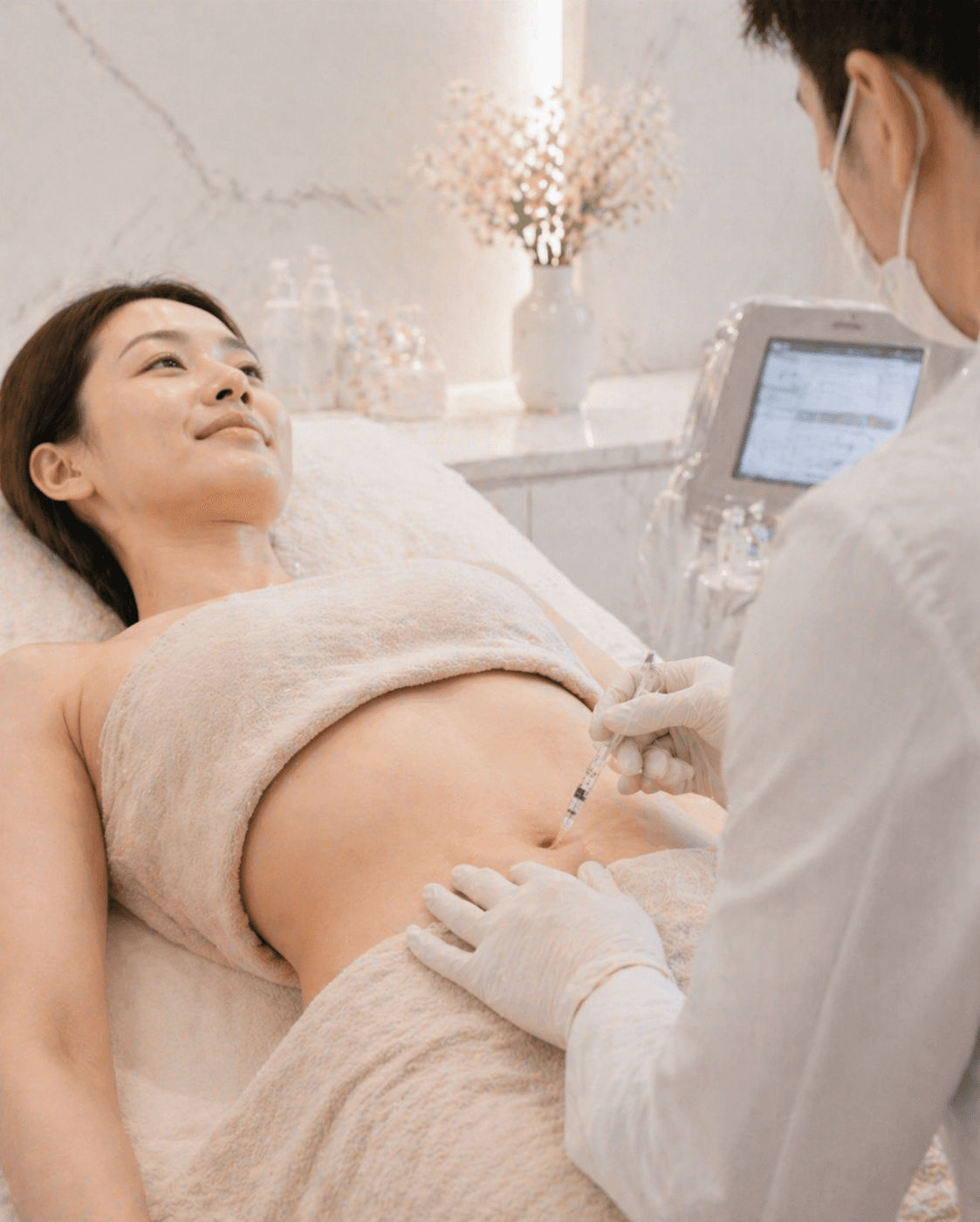

Basic aftercare is provided as a standard programme of 12 sessions in total — 4 swelling-care, 4 radiofrequency, 2 scar-laser and 2 meso-injection sessions. Actual scheduling and completion may vary depending on your ability to attend.
If care is needed beyond the basic aftercare, NB surgery patients receive a 50% discount on the standard price.
Legal Notice
※ If care cannot be provided due to reasons such as equipment malfunction, the affected care item may not be offered; as a service item, it is non-refundable.
※ Depending on your constitution and healing process, side effects such as swelling, bruising, inflammation, and scarring may occur after surgery.
NB Abdomen Design
See the abdominal line plan that suits your body type for yourself
NB Plastic Surgery, Sinsa, Gangnam
02-3446-7575 · 02-3446-9009