

Pectoral Design · Dynamic Lower Border · Layer-Depth
When the chest line changes, the whole upper body reads differently.
High-definition pectoral design is not simply about enlarging the chest; it evaluates upper-chest volume, the lower pectoral border, the chest-to-shoulder connection and the upper-body frame together to design a more masculine chest contour.
My chest concern type
Which chest concern is yours?

Empathy
If the lower chest border stays faint
despite training
- The lower chest line stays blurry despite upper-body training
- The inferolateral contour looks weak when you raise your arms
- The upper chest below the collarbone looks thin
- The pectoral line never shows through shirts or T-shirts
- Left–right chest balance is hard to achieve with exercise alone
- A busy routine leaves too little time to train
The pectoral border is not built by training volume alone
Upper-chest volume, the lower border, the inferolateral line, the shoulder connection — an area completed by precise design.Chest Type
A design direction
for each male chest type
Male chests read differently by type. Rather than applying one identical line, we set the design direction that fits your own type.
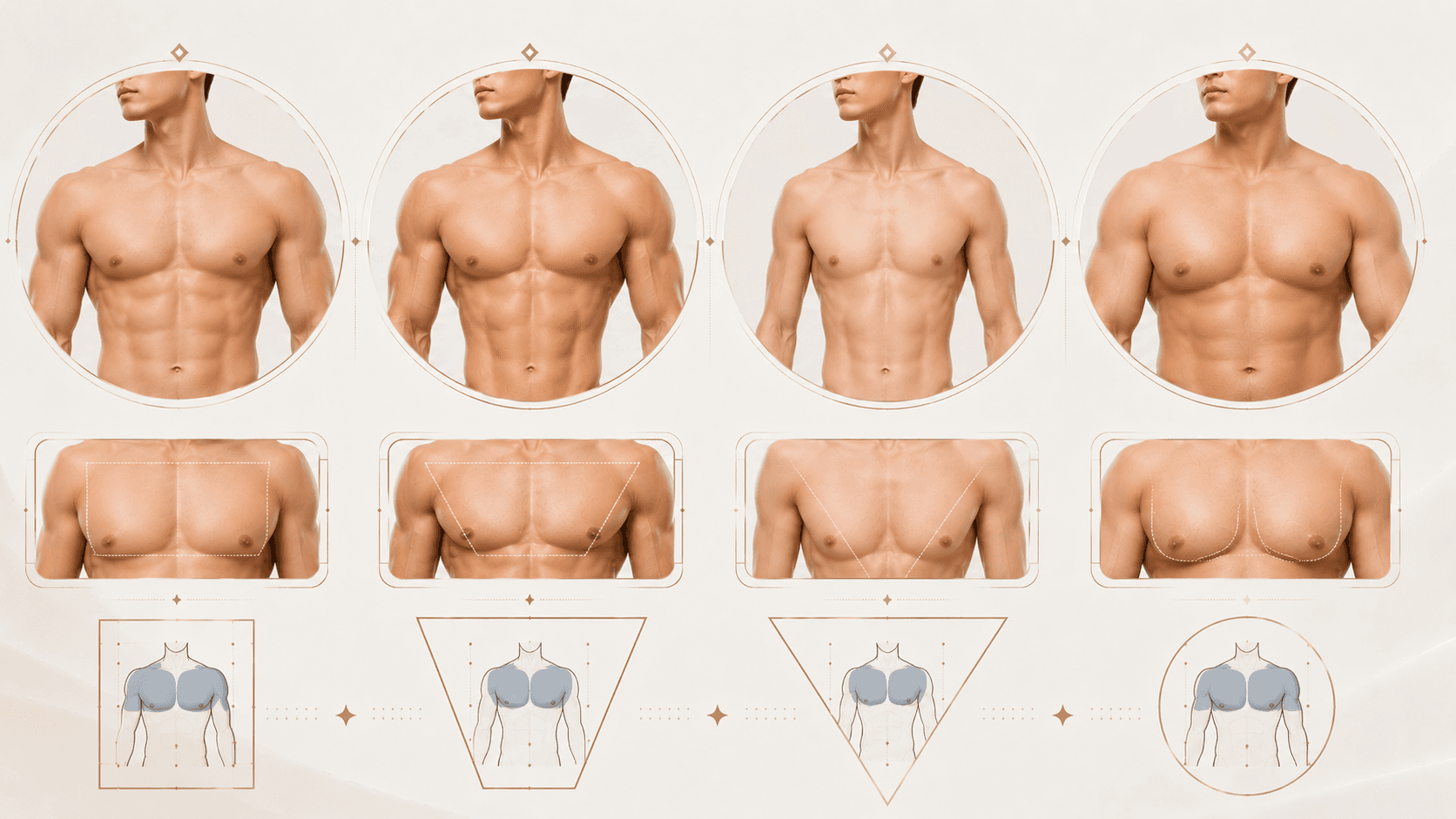
Linear inferolateral type
The outer-lower chest line falls relatively straight rather than curving in, and the lower midline can look slightly open. Often seen in builds with a relatively narrow shoulder frame; we design a masculine chest contour by reading the lower border and inferolateral line together.
Triangular type
The inferolateral lines narrow as if gathering, giving an impression that emphasizes the mid-chest. Often seen when the upper-body frame is not broad or the supporting inferolateral line is weak, so we assess the inferolateral and lateral lines together.
Inverted-trapezoid type
Broad shoulders and a relatively slim waist make the upper body read as an inverted trapezoid. Often seen in mesomorphic builds with pectoral projection; rather than adding heavy volume, what matters is tidying the lower border, the lateral line and the connection into the upper abdomen so the masculine frame reads more clearly.
Round type
The outer-lower chest connects in a soft, rounded flow. Often seen in bigger builds or those with a fat layer; when the pectoral border blurs, the chest can look rounded and spread. Here, rather than simply adding volume, we assess the fat layer, the lower border and the lateral line together.
Dynamic Lower Border
A lower pectoral line that changes
with arm position
The lower pectoral border and the inferolateral line read differently with arms down versus raised. Designing from a single still frame changes how it reads in everyday motion, so the dynamic line has to be assessed as well.

Arms down
We assess where the lower pectoral border falls most naturally.
Arms raised
We assess how the inferolateral line changes and connects to the side.
Inferolateral border
The region that changes most with arm movement — it needs precision design.
Posture, motion & fit
Not one frozen frame, but everyday motion and how clothes read on the body.
Layer Depth Principle
Designed with the superficial
and deep layers apart
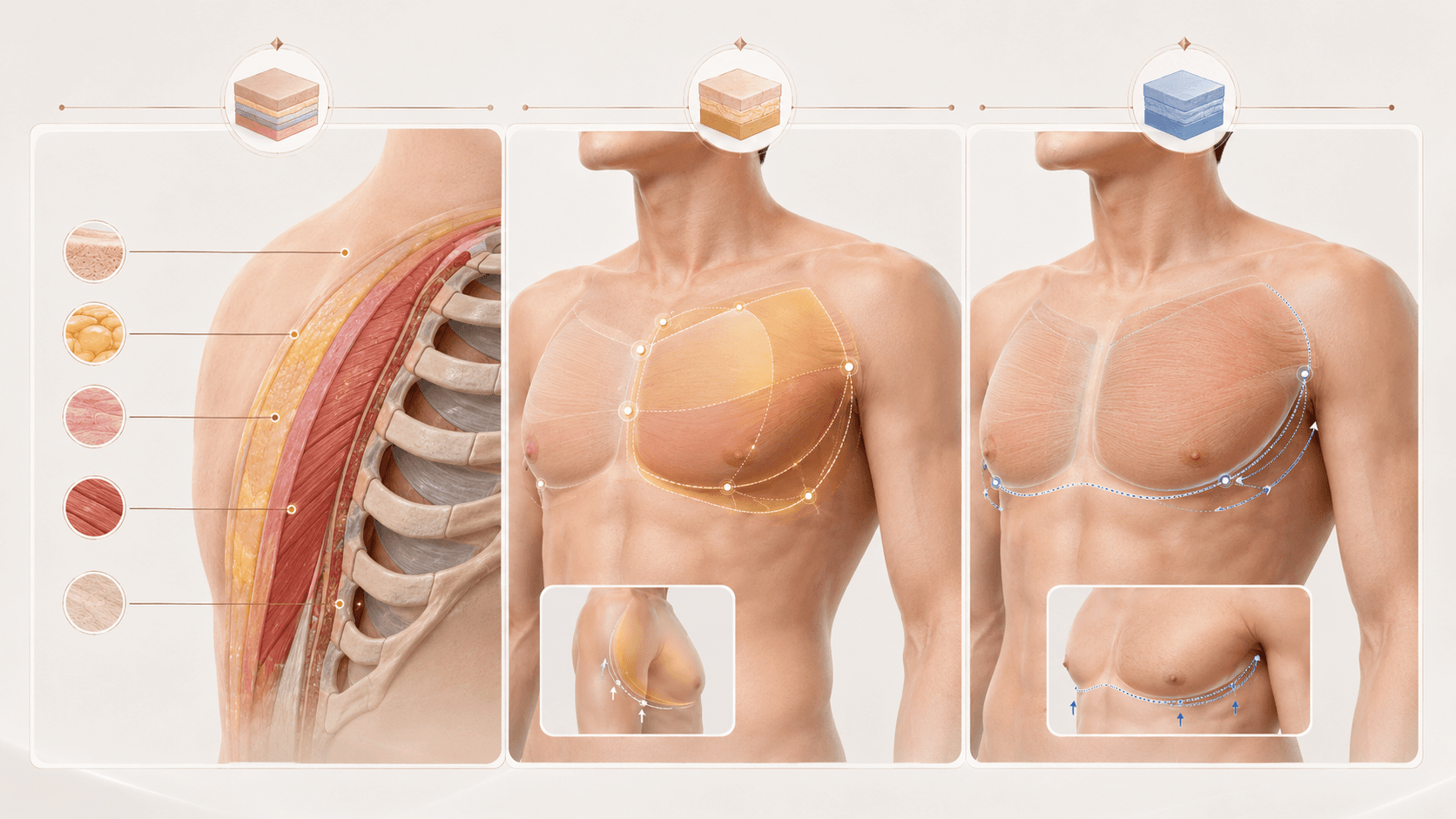
Pectoral design is not surface contouring alone. The superficial layer decides the surface contour and the softness of the lower border; the deep layer decides volume support and dimension. Only assessing the two layers separately produces a natural impression.
Superficial — surface contour
Decides the lower pectoral border and the softness of surface transitions.
Deep — volume support
Decides upper-chest volume and the support behind the chest’s dimension.
Layer-plane planning
Each layer is assessed on its own to decide how far to refine each region.
Border continuity
The key is connecting the layers so the border between them never breaks.
Design Method & Principle
The design method — lower border, lateral line, upper-abdomen connection
Rather than adding volume unconditionally, we design a masculine chest line by reading the fat layer and muscle contour together with the lower chest border, the lateral line and the connection into the upper abdomen.
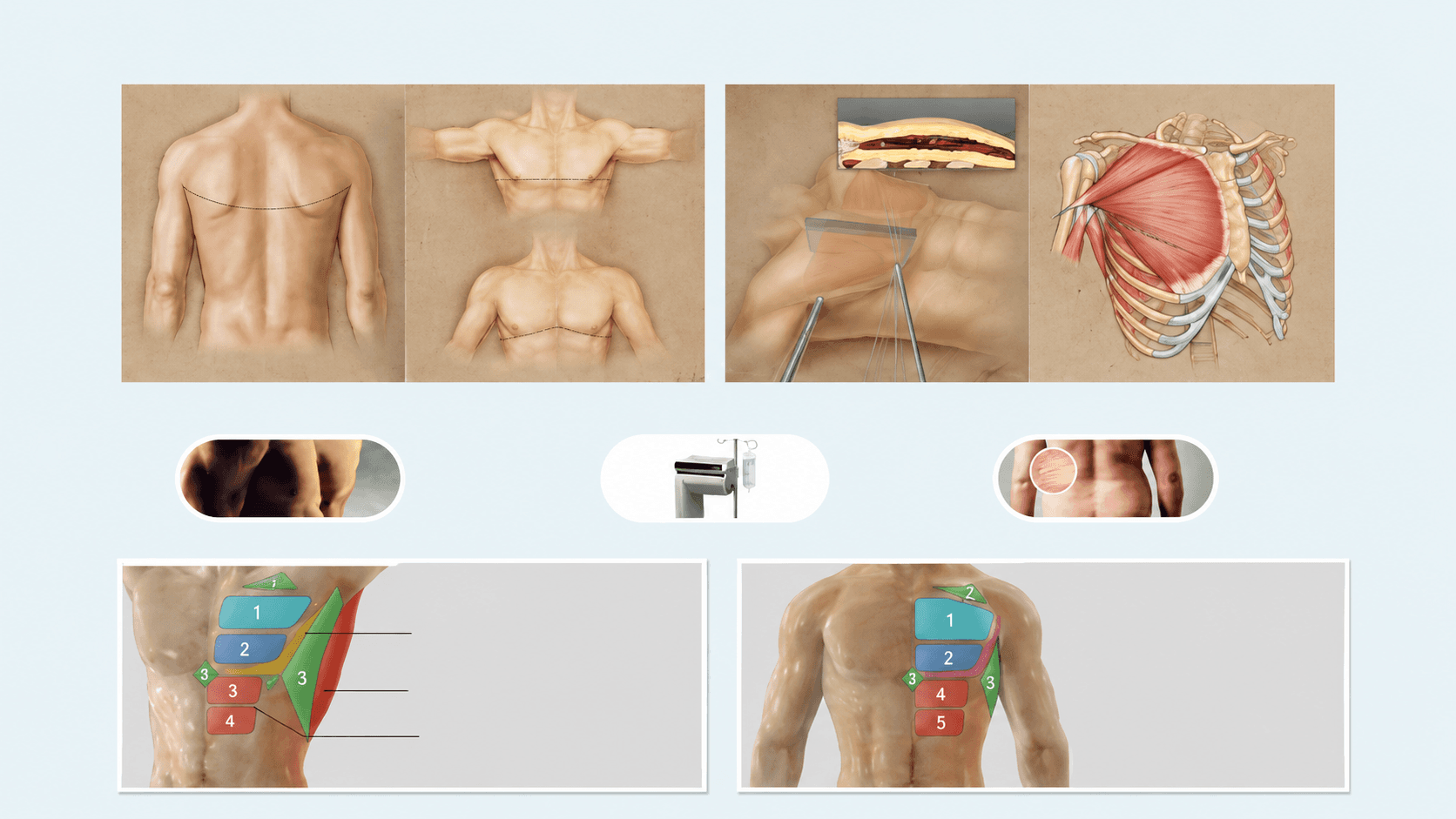
- Upper ChestUpper-chest volume below the collarbone and where the line begins
- Lower BorderStrength and left–right symmetry of the lower pectoral border
- LateralThe lateral-to-inferolateral line — the region that decides the side profile
- Frame LinkThe pectoral–shoulder–abdomen connection and the upper-body frame impression
Why NB
What sets NB high-definition pectoral design apart
Dynamic line assessment
We assess the lower and inferolateral lines as they change with arm position and motion.
Layer-by-layer precision design
The superficial and deep layers are separated and designed each for its own role.
Precise left–right balance analysis
Precision analysis designs naturally symmetric pectorals.
A natural, adhesion-free line
An adhesion-minimizing principle keeps the pectoral line natural after the procedure.
NB Design Solution
Concern → design match
A blurred lower border
→Precision lower-border contouring
Designs a natural lower border in both arms-down and arms-raised positions.
A weak inferolateral line
→Inferolateral line design
Reads the lateral and inferolateral contours together to tidy how clothes fit.
A thin upper chest
→Deep-layer upper-chest volume
Reinforces upper-chest thickness and presence with deep-layer volume.
Weak for the frame
→Integrated frame design
Reads the pectoral–shoulder–abdomen connection together to design the upper-body frame impression.
Consultation & Ultrasound
Ultrasound-based analysis
& design planning
The dynamic line and each layer’s thickness are examined directly on ultrasound before the procedure, then we design quantitatively how far to refine and what to preserve.

- Pectoral thickness and position measured in millimetres
- Fat layer, glandular tissue and muscle borders compared left to right
- Depth and amount decided per region in advance
- Sagging and possible gynecomastia assessed as well

A sharper pectoral silhouette, even at the pool
High-definition pectoral design is not about making the chest look bigger; it designs the lower border and inferolateral contour to read naturally, so the upper-body impression stays sharp even the moment the clothes get lighter.
The NB standard of results
What changes
A natural impression when the line is read across arm positions
Superficial and deep layers designed each for its role by region
Natural symmetric design based on precision analysis
A natural line maintained by an adhesion-minimizing principle
Why choose NB high-definition pectoral design
- Pectoral design experience grounded in dynamic line assessment
- A principle of designing the superficial and deep layers separately
- Design based on precise left–right balance analysis
- An adhesion-minimizing surgical technique
- Consultation and surgery performed by the head surgeon
FAQ
Frequently asked questions
Q. How is this different from gynecomastia correction?
Gynecomastia is caused by glandular development, while pectoral design aims at pectoral line definition. We distinguish the two precisely in consultation before designing.
Q. Why isn’t exercise alone enough?
The pectoral border only shows when muscle development and fat-layer cleanup come together. Exercise alone cannot control the thickness of the fat layer.
Q. How long is recovery?
On average, return to daily life in 1–2 weeks and compression care for 4–6 weeks. The chest moves a lot, so strenuous activity needs to be limited. Recovery can vary by individual.
Q. Will there be visible scarring?
Incisions are minimized and placed around the axilla or areola so scars are barely visible. Results can vary with tissue condition.

After surgery, with you through recovery
- 01VersaClear light therapy2 sessions
- 02Ucell standing-wave therapy2 sessions
- 03Radiofrequency care4 sessions
- 04
 Soft-meso injection· Performed by the doctor2 sessions
 - 05
 Fraxel scar laser· Performed by the doctor2 sessions
Basic aftercare is provided as a standard programme of 12 sessions in total — 4 swelling-care, 4 radiofrequency, 2 scar-laser and 2 meso-injection sessions. Actual scheduling and completion may vary depending on your ability to attend.
If care is needed beyond the basic aftercare, NB surgery patients receive a 50% discount on the standard price.
Legal Notice
※ If care cannot be provided due to reasons such as equipment malfunction, the affected care item may not be offered; as a service item, it is non-refundable.
※ Depending on your constitution and healing process, side effects such as swelling, bruising, inflammation, and scarring may occur after surgery.

Consultation
Pectoral design consultation
Find out first how far your chest can go.
Send a photo on KakaoTalk and we’ll analyze and reply quickly.