

Thread Lifting Design
We design the direction of sagging before we choose a thread
Cheek sagging, a blurred jawline, marionette lines and lower-face heaviness are assessed together with skin thickness and tissue weight to design a natural lifting direction
30-Second Thread Lift Guide
Find the thread lift direction that suits your face
A thread is not chosen by type first — it is designed around the direction of sagging, skin thickness and tissue weight.
The following is a reference direction to consider before consultation.
Step 1 · Select all that apply
Which change bothers you most?
Step 2 · Select one
Which best describes the degree of sagging?
Step 3 · Select one
How does your facial tissue feel?
Step 4 · Select one
What direction of improvement do you want?
Step 5 · Select if applicable
Are there any conditions that need caution?

Empathy
You have not really gained weight, yet the lower face looks heavy
In photos the jawline can look less defined than before, with the cheeks descending and the mouth area appearing heavy. Pulling harder is not the answer — what matters is first examining which direction the tissue has descended. Even with the same sagging, facial conditions differ from person to person.
Facial changes where a thread lift may help
Even the same sagging differs by area and tissue condition; suitability is confirmed in consultation.

Cheek
Cheek sagging
When gravity draws the cheeks down and the lower face looks heavy, this approach sets a direction and supports the tissue.
Jawline
Blurred jawline
When a once-defined jawline becomes blurred and the impression looks dull, it can be reviewed as a way to refine the contour.
Marionette
Marionette lines
When the marionette lines running down beside the mouth look heavy, we examine the supporting direction together.
Nasolabial
Nasolabial heaviness
When the nasolabial area sags and looks heavy, we assess tissue weight and direction together.
Under Chin
Under-chin · lower-face heaviness
Reviewed when the under-chin and lower face look dull. That said, a thread lift alone may have limits in this area.
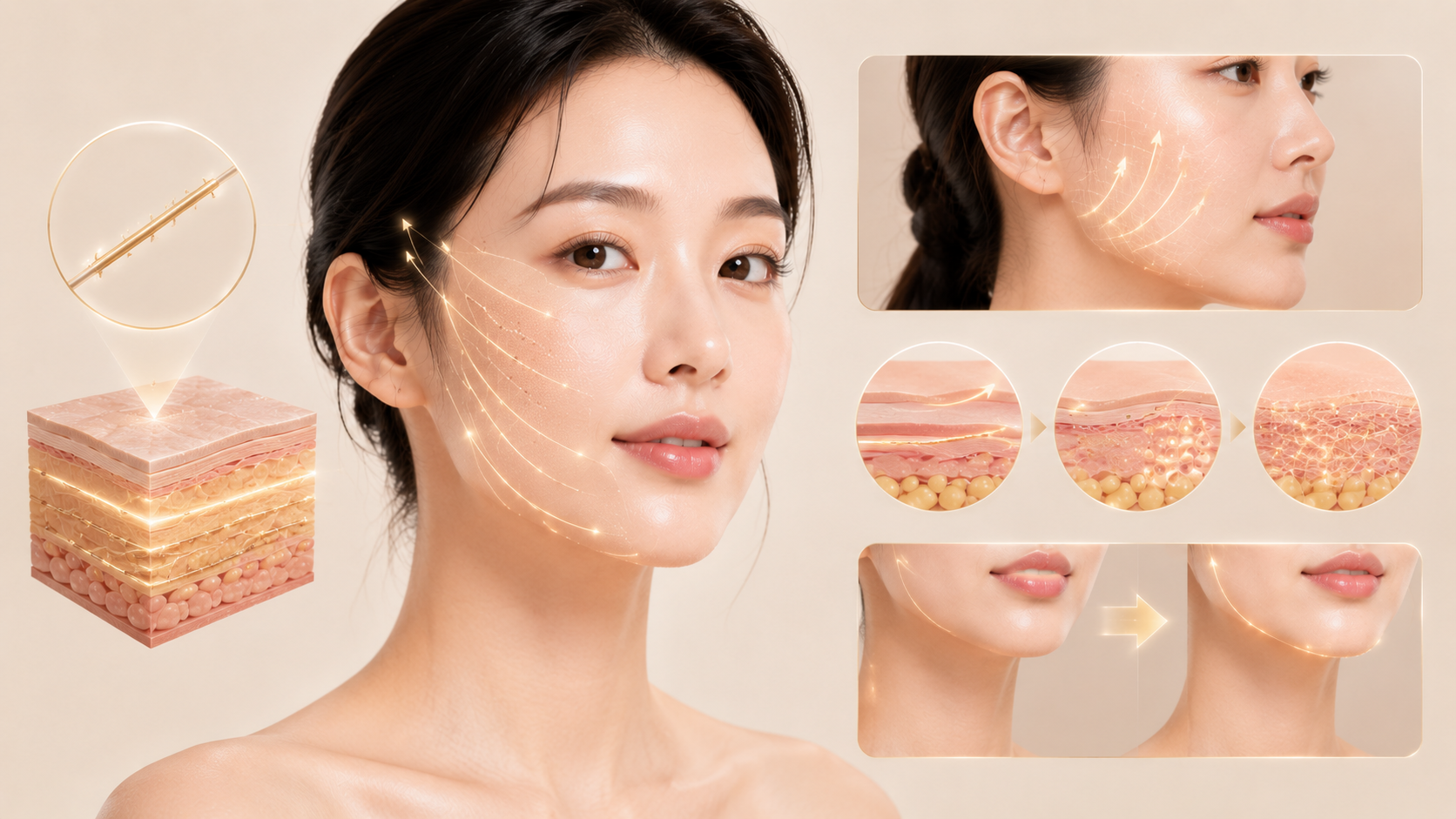
How It Works
Traction and support, designed together
Absorbable threads are placed in the soft-tissue layer to support sagging tissue along a chosen direction. Depending on the thread type and structure, the feel of support, flexibility, tendency to last and tissue response can differ. Rather than which thread is best, what matters more is which thread and vector suit your facial tissue.
Not better or worse, but different in character
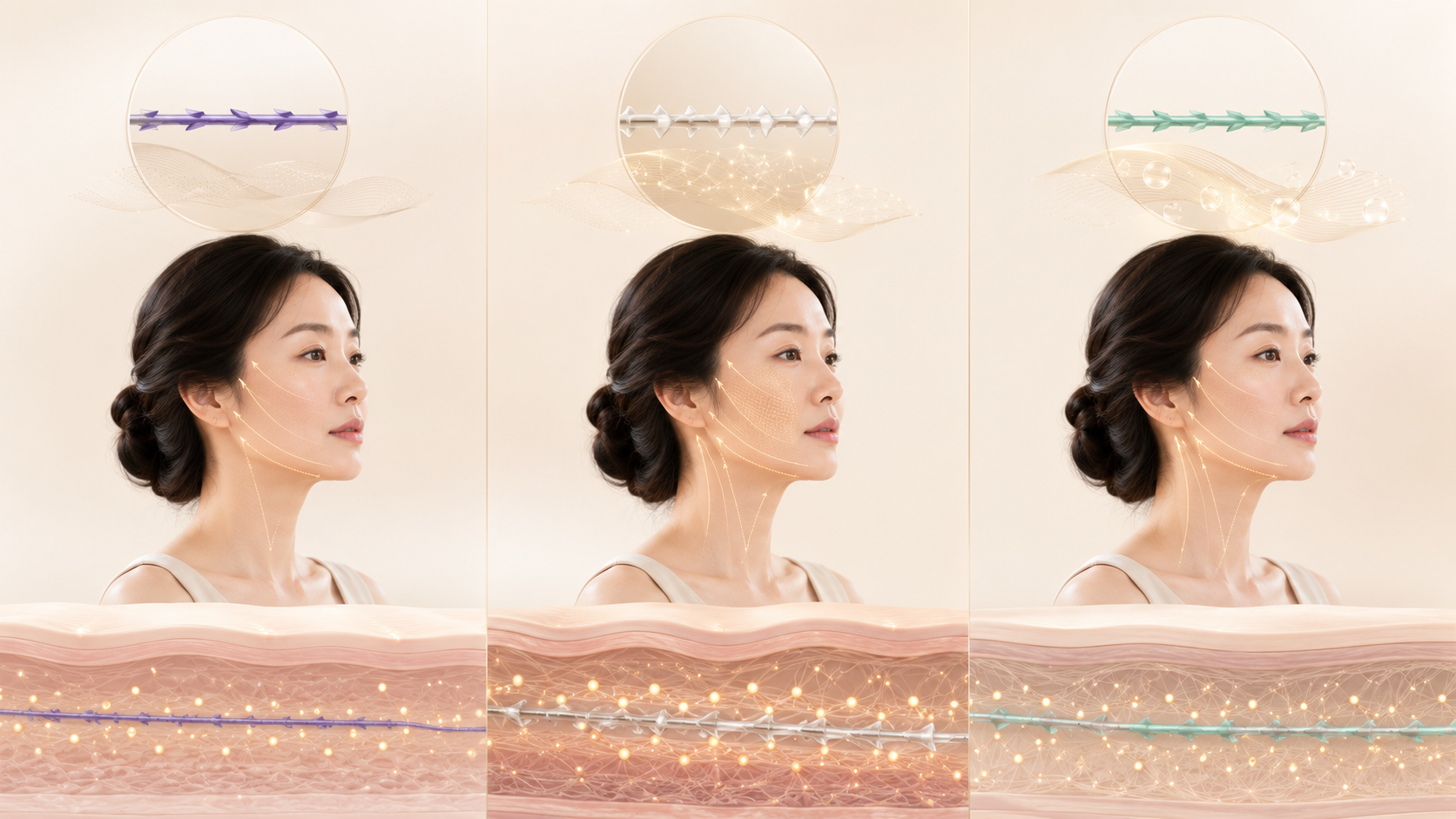
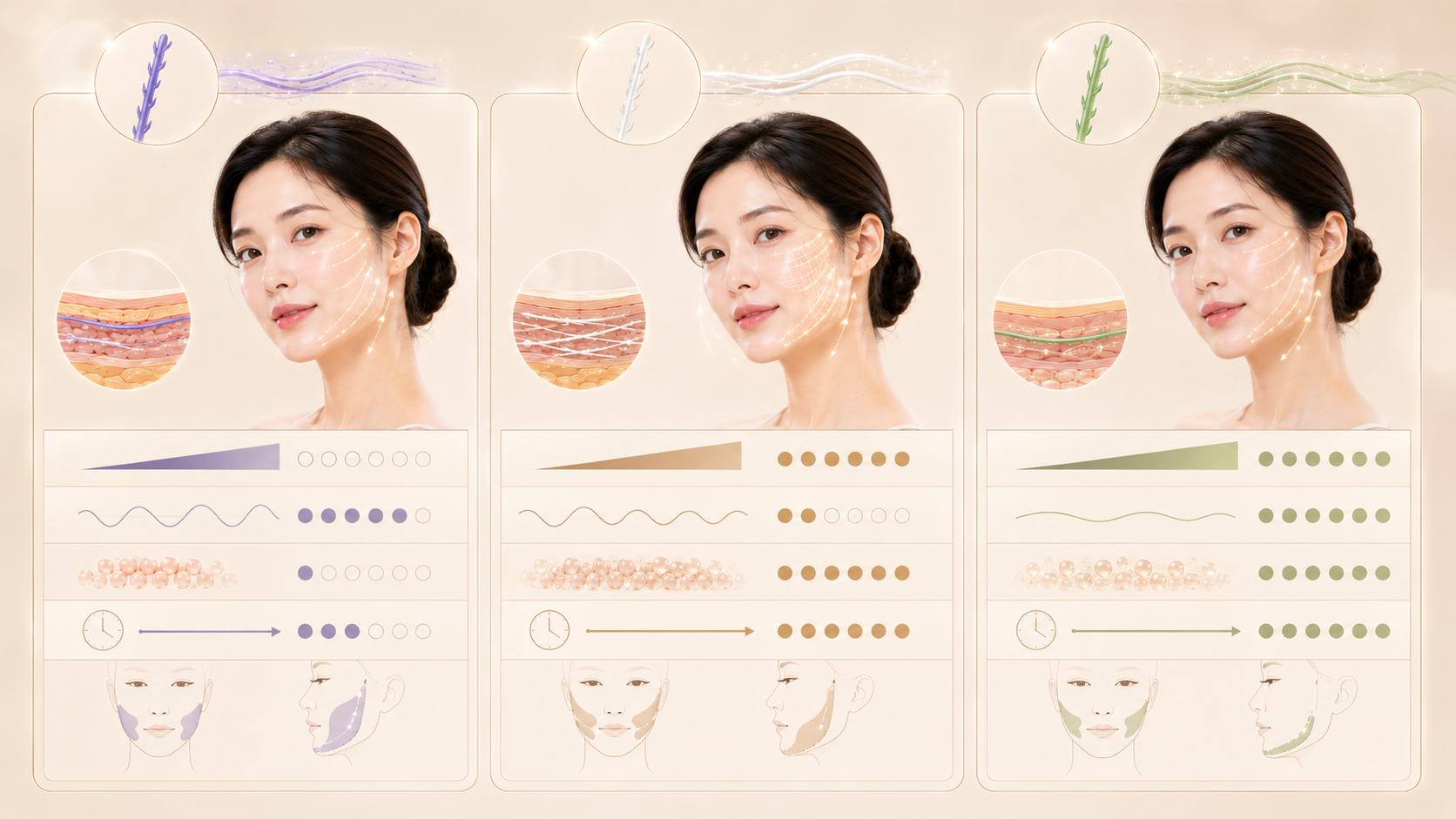
PDO, PLLA and PCL are not ranked against each other — they are materials with different approaches.
Basic Support
PDO
A material that takes a relatively gentle, basic lifting direction. It can be reviewed for early sagging or for maintenance purposes.
Collagen Support
PLLA
A material oriented toward a collagen-supporting response. It can be reviewed when firmness reinforcement is also being considered.
Flexible Support
PCL
A material oriented toward flexibility and a sustained tendency to support. It can be reviewed depending on tissue conditions.
Even with the same PDO, PLLA or PCL, results can differ according to thread thickness, barb structure, insertion layer and treatment vector, so the choice should not be made on the material name alone.
Your facial condition comes before the material name
Before deciding which thread to use, we first look at the condition of your face.

Direction
Direction of sagging
The vector along which threads are anchored changes with the direction in which tissue has descended.
Thickness
Skin thickness
Whether the skin is thin or thick, we review the insertion layer and thread type differently.
Weight
Tissue weight
If fat and tissue weight is significant, we examine the supporting direction and whether a combined approach is needed.
Vector
Lifting vector
We design the direction and angle of traction for a natural impression.
Naturalness
The naturalness you want
We check together whether you want to avoid an over-pulled look and prefer a composed impression.
Combination
Need for combined treatment
We judge whether firmness, volume or skin-texture concerns need to be addressed together.
When it fits well, and when it has limits on its own
Being honest about the limits is the first step toward a natural result.
Good Fit
When a thread lift is a good fit
- ·When early to moderate cheek sagging is the concern
- ·When the jawline is beginning to blur
- ·When the marionette lines beside the mouth are bothering you
- ·When you want a natural lifting direction that is not overdone
Limits
When it may have limits on its own
- ·When the skin is already considerably loose
- ·When there is a lot of under-chin fat
- ·When loss of volume is the main problem
- ·When sagging is moderate or greater and a facelift may be more suitable
- ·When a strong V-line change is expected
- ·When there is tissue adhesion from a previous procedure
Depending on the situation, a combined approach may suit you better than a thread lift alone.
When firmness is also lacking
A combined lifting laser can be reviewed.
When under-chin fat adds weight
Facial fat reduction can be examined together.
When volume loss is the main cause
We review the volume direction together with filler.
When skin texture and fine lines are also a concern
We look at skin boosters, Rejuran and Juvelook together.
When sagging is on the severe side
A facelift may be more suitable, judged in consultation.

Consultation
Design comes before the number of threads
In consultation we check the direction of cheek sagging, the blurring of the jawline, and the state of the marionette and nasolabial areas. We look at skin thickness and firmness, fat weight and the level of change you want, and set a direction from there. How the lift is designed comes before how many threads are used.
Procedure flow and recovery
Consultation · assessment
We check the direction and degree of sagging, skin thickness and tissue weight together.
Thread · vector decision
Rather than the material name, we decide the thread type and lifting vector that suit your facial condition.
Design
We design the insertion layer and direction for a natural impression.
Procedure
The procedure proceeds along the designed direction. The anaesthesia method is explained in consultation.
Recovery · course
Bruising, swelling, tightness, a foreign-body sensation and temporary asymmetry may occur, and the degree varies from person to person.
The course of recovery and the degree of response vary from person to person, and it is best to be advised on detailed precautions in consultation.

Impression
A composed impression rather than a pulled face
The goal is not a face that obviously looks pulled, but an impression that simply looks composed. Rather than excessive change, we aim to refine your original impression naturally. Results and the course of recovery may vary from person to person.
Thread lift frequently asked questions
Q. Which is better among PDO, PLLA and PCL?
Each material simply has different characteristics; one is not superior to another. The thread that suits a face differs from person to person, so rather than the thread name, it is better to decide together in consultation based on your direction of sagging and tissue condition.
Q. How long does it last?
It can vary with the material, thread structure, treatment area and individual differences, so a specific duration is hard to state definitively. Because the tendency differs with tissue condition and aftercare, it is better to confirm this together in consultation.
Q. Can a thread lift alone refine the jawline?
It may help with early to moderate blurring of the jawline, but if the degree is significant, it may have limits on its own and a combined approach may be needed. We judge this in consultation after looking at tissue weight and the degree of sagging.
Q. Can the threads be felt or seen through the skin?
If the skin is thin or the insertion is shallow, that possibility has to be taken into account. It is better to check these conditions in advance and adjust the insertion layer and thread type.
Q. What about swelling and bruising?
Bruising, swelling, tightness and a foreign-body sensation may occur, and the degree and duration vary from person to person. It is best to be advised on the course of recovery and precautions in consultation.
Q. How does a thread lift differ from a lifting laser?
A thread lift supports tissue along a chosen direction, while a lifting laser uses heat energy to assist firmness. Their purposes differ, so they are sometimes planned together; which one suits you is confirmed in consultation.
Explore together
Hybrid Lift
When a thread lift alone falls short, we look at designing support and contour together.
Hybrid Lift →LaserLifting Laser
When firmness is also a concern, we compare heat-based lifting directions.
Lifting Laser →FatFacial fat reduction
Reviewed together when under-chin and lower-face heaviness is the main cause.
Facial fat reduction →FaceliftFacelift
Explored when sagging is moderate or greater and a more fundamental approach is needed.
Facelift →The direction your face sags comes before the name of a thread
We look at the direction of sagging and tissue condition before the material name. We judge the direction together through consultation · NB Plastic Surgery, Sinsa, Gangnam

After the procedure, with you when needed
Petit procedures do not include a separate aftercare program; if swelling care is needed after the procedure, it is offered at 50% of the cost.
Legal Notice
※ If care cannot be provided due to reasons such as equipment malfunction, the affected care item may not be offered; as a service item, it is non-refundable.
※ Depending on your constitution and response, reactions such as swelling, bruising, and inflammation may occur after the procedure.