
01
Muscle
Muscle-type
This is when calf muscles such as the gastrocnemius are developed, making the thickness stand out. When standing on tiptoe, the calf shape tends to firm up and the contour becomes more pronounced.

NB Calf · Flow Design
We plan the calf line by assessing muscle, fat layer, ankle transition and leg proportion together.
Self-Check
If even one of these applies, we can look at your calf line flow together
Have your calf cause assessedEven with the same calf concern, the approach differs depending on the cause
Muscle-type, fat-type, edema tendency and ankle transition are assessed differently and point in different directions, even at the same thicknessYour Concerns
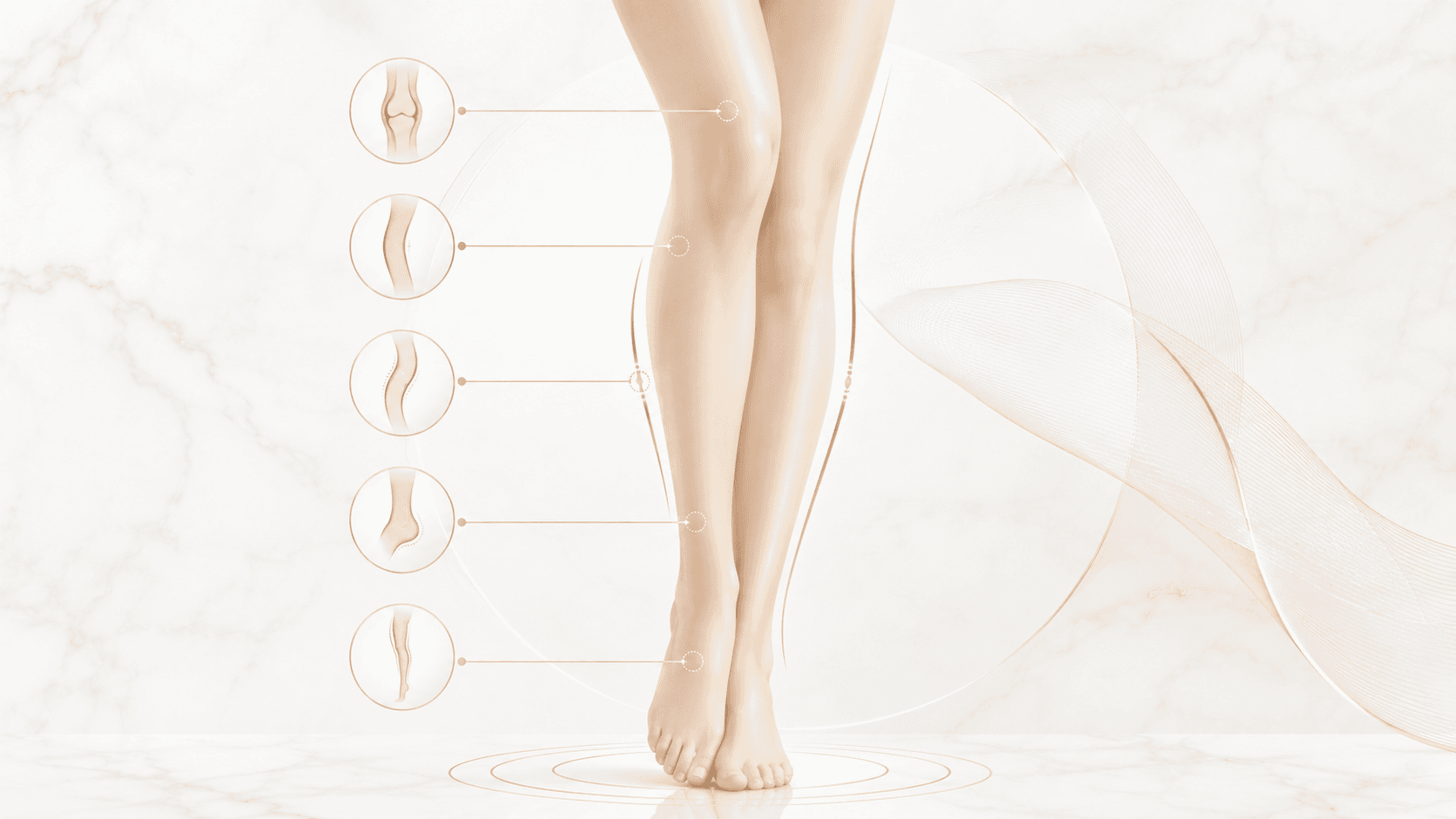
The impression of slim ankles is determined less by the calf itself than by the knee–calf–ankle connection.
Calf Line Planning
The start below the knee, the inner and outer curves, the ankle transition and the overall leg proportion each create a different impression. Reducing based on one part alone can make the other lines look awkward, so we look at the four flows together.
The calf line is determined at the starting section just below the knee. Only by looking at the thickness and flow of this start together does the whole calf look natural.
The inner and outer curves of the calf create different impressions. Reducing based on only one side can make the front and rear proportions look awkward.
The impression of a slim ankle is determined less by the calf itself and more by the transition line running from knee to calf to ankle.
Reducing based on the calf alone can throw off the balance with the thigh and above the knee, so we consider calf thickness within the flow of the whole leg.
The four flows above are a general perspective for line evaluation, and the actual achievable range may vary by individual condition after assessment and consultation.
Cause Analysis
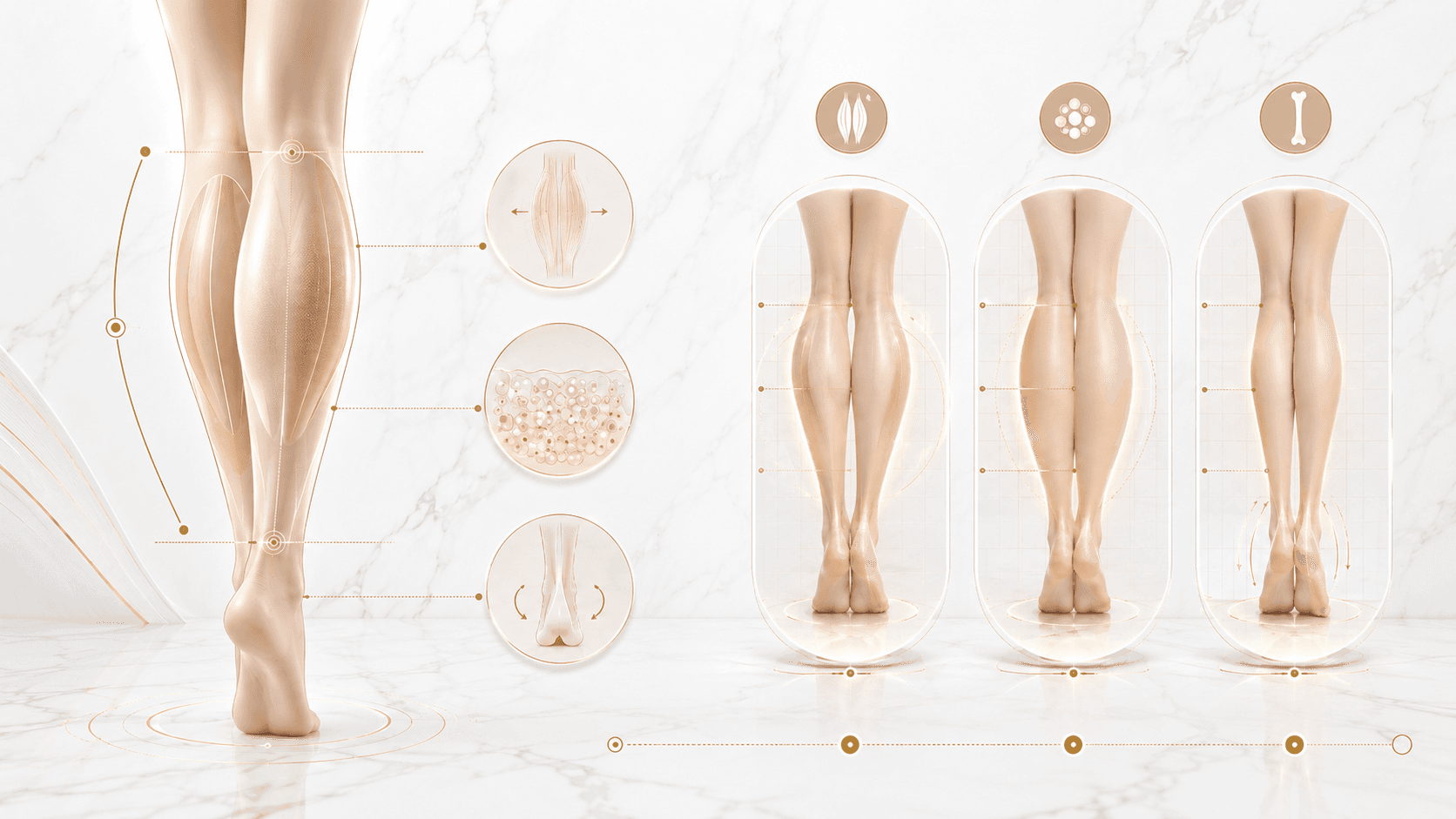
Calf enlargement can stem from different causes — muscle, fat layer, edema tendency, ankle transition, left–right difference — so approaching it by thickness alone can make the line hard to refine.
01
Muscle
Muscle-type
This is when calf muscles such as the gastrocnemius are developed, making the thickness stand out. When standing on tiptoe, the calf shape tends to firm up and the contour becomes more pronounced.
02
Fat
Fat-type
This is when a thick fat layer makes the whole calf look softly thickened. The circumference does not change much with posture, and it feels softer when pinched.
03
Mixed
Mixed-type
This is when muscle and fat together create the thickness. Approaching from only one side may make it hard to refine the line, so we evaluate it in an integrated way.
04
Edema
Edema tendency
This is when the calf circumference tends to change after standing or sitting for a long time. When an edema tendency is present, the timing of line evaluation and the recovery process can differ.
05
Transition
Ankle transition issue
This is when the impression of thickness comes not from the calf's own volume but from an ankle transition that is not smooth. We look at the connecting line before the calf itself.
06
Asymmetry
Left-right difference
This is when the two calves differ in thickness and muscle development. Looking at only one side as the reference can leave the two out of alignment, so we compare both legs together in planning.
The categories above are a general guide to the evaluation perspective, and the actual classification and approach are decided after assessment. This content does not replace medical care.
Isolated vs Flow
Even when handling the same thickness, an approach that looks only at the calf and one that looks at the whole-leg flow can create a different impression of the line.
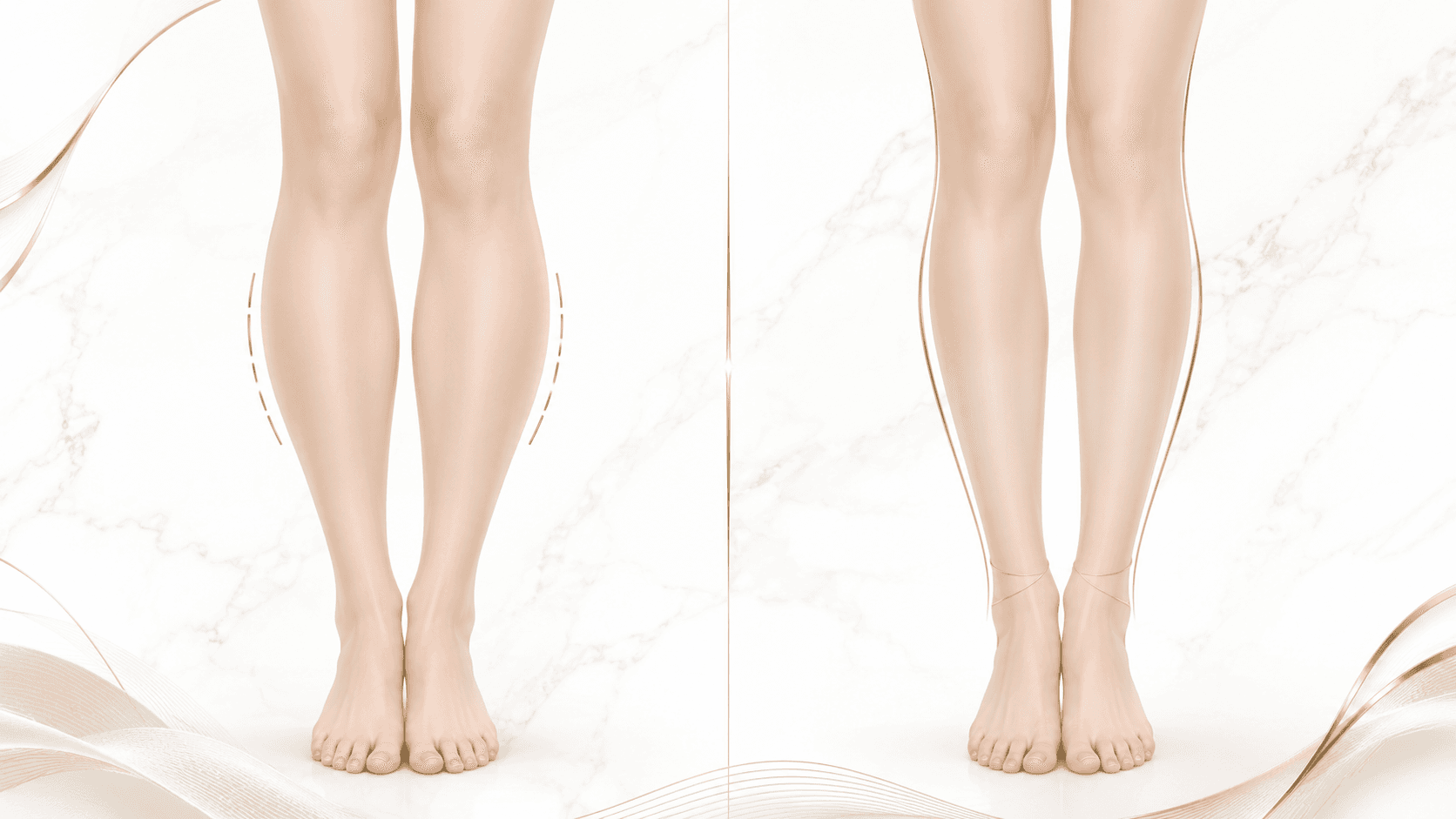
What matters is not reducing a lot but a flow that runs naturally from below the knee to the ankle
Diagnosis Planning
Even at the same circumference, the approach can differ depending on muscle, fat, skin, ankle transition, edema, asymmetry, overall proportion and prior procedure history.
Muscle
We check the degree and shape of development of calf muscles such as the gastrocnemius together.
Fat
The approach and range can vary depending on the distribution and thickness of the fat layer.
Skin
We evaluate skin elasticity, recovery potential and any sagging together.
Ankle
We check the flow of the transition line running to the ankle and the difference in thickness.
Edema
We check lifestyle patterns and edema tendency together and reflect them in the evaluation timing and recovery plan.
Balance
We plan while comparing the differences in thickness, muscle and line between the two calves.
Ratio
We view calf thickness within the proportion of the thigh, above the knee, calf and ankle.
History
We check whether there is any history of Botox, liposuction or other procedures.
The items above are a general guide to diagnostic evaluation, and the actual scope and feasibility of a procedure or surgery are decided by individual condition after medical care.
Why NB
01
Whole Leg View
A whole-leg line perspective
We see the calf not as a standalone area but as part of the whole-leg line running through the thigh, above the knee, calf and ankle.
02
Cause-First
Cause assessment first
We first evaluate causes such as muscle, fat, edema tendency and ankle transition, then decide the direction of the approach. Even with the same thickness, a different cause leads to a different answer.
03
Natural Line
A natural flow over excessive reduction
Rather than reducing a lot, we prioritize a line that runs naturally from below the knee to the ankle.
04
Method Match
Guidance that distinguishes methods
When needed, we distinguish and guide the direction of procedure, surgery or management, and do not recommend an overreaching combined approach.
Related Lines
Thigh 360°
Heoeongmu integrated design
A leg line design that sees the thigh, under-buttock and knee in a 360° flow
Knee design
Knee line design
A design that looks at the above-knee and side lines together with the calf-start connection
Creating a thigh gap
Inner thigh and between-the-legs line
A whole-leg flow design covering the inner thigh, above the knee and the hip connection
Full-body design
Full-body line integrated design
An integrated line design that looks at the abdomen, waist and lower body together

The flow that falls below the knee when you are dressed
The lower-body line revealed in skirts, boots and slim-fit trousersFlow Design · Whole Leg View · Natural LineNB Approach
Recovery & Care
The calf is an area where swelling and firmness can remain visible for a relatively long time. A recovery process that follows the compression guidance and walking adjustments step by step is important.
Day 1–3
Compression wear and walking possible; swelling-management stage
Week 1
Return to daily life begins; avoid long-distance walking and strenuous exercise
Month 1
Swelling decreases and the calf line contour begins to appear
Month 3+
The line settling stage; final refinement may need more time
01
The calf is an area where swelling and firmness can be visible for a relatively long time. It stabilizes step by step as time passes.
02
To stabilize the line, it is good to follow compression stockings or a compression guide for the period advised.
03
Long-distance walking, strenuous exercise and strong stretching are adjusted step by step while watching your recovery.
04
To support tissue recovery and ease firmness, aftercare programs such as radiofrequency can be combined step by step.
05
A muscle-type approach (such as Botox) and a fat-type approach (such as liposuction) can differ in recovery pattern and speed of return to daily life.
06
The recovery process and final line vary by individual depending on muscle development, fat layer, skin elasticity, edema tendency and lifestyle patterns.
The recovery guidance above is a general guide, and the actual recovery speed and line-refinement process may vary by the approach (muscle-type/fat-type, etc.) and individual recovery capacity.
FAQ
The same calf concern can call for a different answer depending on the cause. The content below is general guidance and does not replace medical care.
Q. Can the calf be resolved with liposuction alone?
When the cause is mainly the fat layer, a liposuction-type approach may be considered. When muscle development is pronounced, liposuction alone may have limits, so the direction of the approach can change after assessment.
Q. How do a muscle-type calf and a fat-type calf differ?
A muscle-type calf tends to firm up and show a pronounced contour when standing on tiptoe, while a fat-type calf changes little with posture and has a softer sense of thickness. However, rather than self-judgment, we distinguish them through assessment.
Q. Can the ankle line improve at the same time?
The impression of a slim ankle is often determined less by the calf itself and more by the knee-calf-ankle transition line. An approach that looks at the ankle transition together, not just the calf, can help.
Q. Won't reducing the calf too much look awkward?
Excessive reduction can throw off the leg proportion or make the line look broken. Rather than reducing a lot, we prioritize a flow that runs naturally from below the knee to the ankle.
Q. How long is the recovery period?
The calf is an area where swelling and firmness can be visible for a relatively long time. The time to return to daily life and to final line refinement may vary by the approach and individual recovery capacity.
Q. How do calf Botox and surgical methods differ?
Botox is a procedure category that affects muscle volume, and it is evaluated differently in terms of how long the effect lasts and whether it is repeated. Surgical methods approach the fat layer or line structure, with a different recovery process and pattern of change. Feasibility and direction are decided after assessment.
Q. How is the consultation handled if I tend to swell a lot?
When an edema tendency is pronounced, the circumference can look different depending on the evaluation timing, so we first check the edema tendency together with lifestyle patterns. Depending on the case, the way the line is evaluated may vary.
Q. Should it be seen together with the thigh or above-knee line?
Reducing the calf alone can throw off the balance with the thigh and above the knee. It is recommended to view calf thickness within the flow of the whole-leg line.
This content is general guidance and does not replace medical care. The actual achievable range and recovery plan are decided after assessment and consultation.



Basic aftercare is provided as a standard programme of 12 sessions in total — 4 swelling-care, 4 radiofrequency, 2 scar-laser and 2 meso-injection sessions. Actual scheduling and completion may vary depending on your ability to attend.
If care is needed beyond the basic aftercare, NB surgery patients receive a 50% discount on the standard price.
Legal Notice
※ If care cannot be provided due to reasons such as equipment malfunction, the affected care item may not be offered; as a service item, it is non-refundable.
※ Depending on your constitution and healing process, side effects such as swelling, bruising, inflammation, and scarring may occur after surgery.
NB Calf Design
Calf line design that assesses muscle · fat · ankle transition · leg proportion together
NB Plastic Surgery · Sinsa, Gangnam
02-3446-7575 · 02-3446-9009